
Find Marriage Records in Graham County
Graham County marriage records date back to the 1880s and are kept by the Clerk of Superior Court in Safford. This rural county in southeastern Arizona offers a simpler, less crowded experience than the larger metro areas when you need to file for a marriage license or request copies of past certificates. The clerk office is on the second floor of the Graham County Courthouse at 800 Main Street. Staff can help you apply for a new license, search for old records, or get certified copies of marriage certificates on file. With lower fees than many Arizona counties, Graham County is a practical choice for couples in this region.
Graham County Marriage License Facts
Graham County Clerk of Superior Court
The Graham County Clerk of Superior Court handles all marriage license matters in this county. The office is in Safford, the county seat. You will find them on the second floor of the Graham County Courthouse. The address is 800 Main Street, Safford, AZ 85546. Call ahead at 928-428-3100 if you have questions or want to check on wait times.
Office hours run Monday through Friday from 8 a.m. to 5 p.m. The fax number is 928-428-0061 if you need to send documents that way. The clerk staff handles marriage licenses, certified copies, court filings, and other Superior Court records. When you visit, bring your ID and any forms you need to complete. The clerk main page has more info on all the services they offer.
Graham County is one of the smaller counties in Arizona. It sees far fewer applications than Maricopa or Pima. This often means shorter lines and faster service. You can usually walk in and get your license the same day without a long wait. Staff know the local community and can answer questions about the process.
Getting a Graham County Marriage License
Both people must appear in person to apply. You cannot send a friend or family member. Bring valid government photo ID like a driver's license, passport, or military ID. The state requires you to give your Social Security number to the clerk under A.R.S. 25-121. This stays private. It is not part of the public record.
The fee for a Graham County marriage license is $83. This is $15 less than the larger counties charge. You can pay with cash, credit card, debit card, or money order made out to the Clerk of the Superior Court. The clerk issues your license the same day you apply. There is no wait. You can marry right after you get it if you want. The license stays valid for 12 months. Use it anywhere in Arizona.
No blood test is needed. Arizona dropped that rule years ago. You also do not have to be an Arizona resident. Couples from out of state can get a Graham County marriage license if they plan to wed in Arizona. Just show up with your ID and fee. The process takes about 30 minutes in most cases. After your ceremony, the person who marries you must return the signed license to the clerk within 30 days per A.R.S. 25-123.
Note: The license expires after one year if you do not use it, and you would have to pay again.
Graham County Marriage Record Copies
Need a copy of an old marriage certificate from Graham County? The clerk can help. Certified copies cost $30. If you know the names and date of marriage, the clerk can pull the record quickly. Marriage records in Graham County go back as far as the 1880s. That gives you access to well over a century of local marriage history.
If you do not know the year of marriage, expect to pay a $30 search fee. The clerk will look through the records year by year until they find a match. To avoid this extra cost, try to gather as much info as you can before you ask. Names of both spouses and at least the decade of marriage will help narrow the search. You can come in person and look through the records yourself at no charge if you prefer to do your own research.
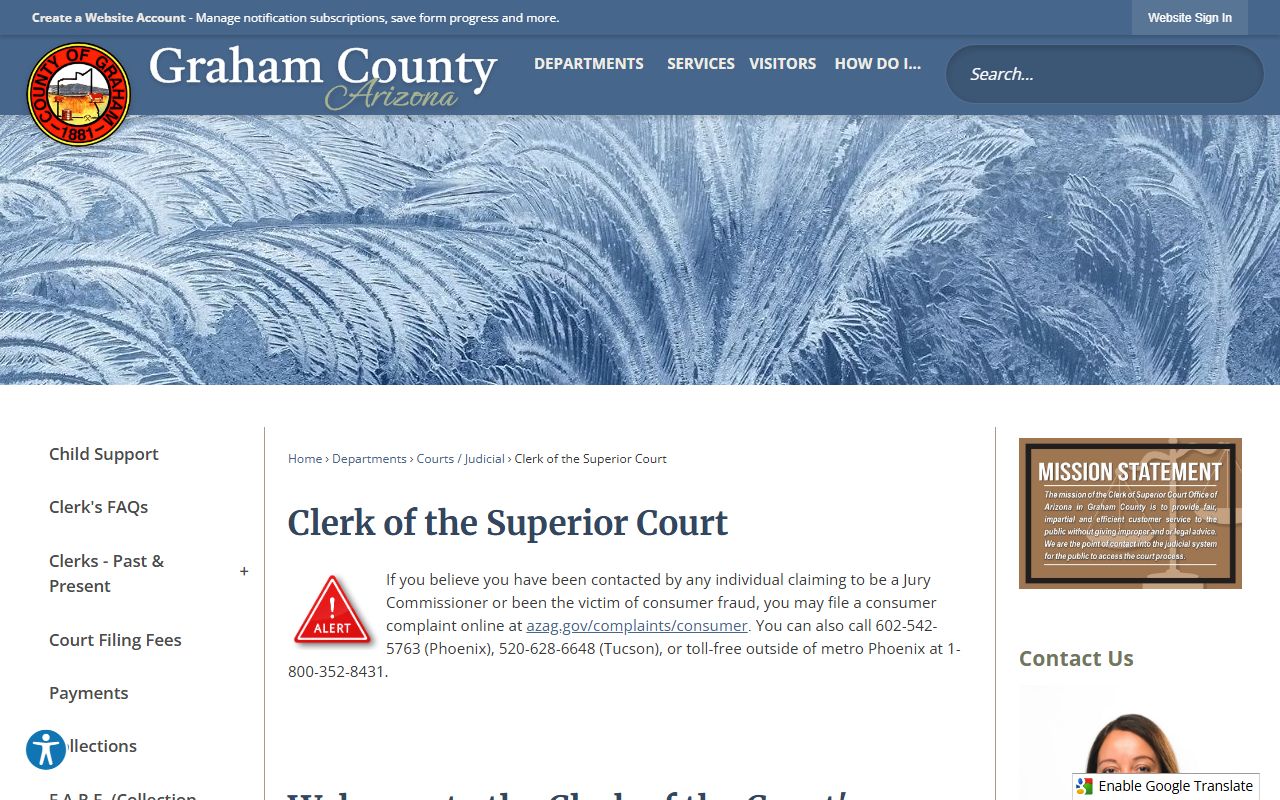
The screenshot above shows the Graham County Clerk of Superior Court website. This is where you can find contact info and details about marriage license services in Graham County.
Mail requests work too. Send a letter with the names of both parties and the date or year of the marriage. Include a check or money order for $30 payable to the Clerk of the Superior Court. Mail it to 800 Main Street, Safford, AZ 85546. Add $30 more if you need the clerk to search for the year. Processing by mail takes one to two weeks in most cases.
Are Graham Marriage Records Public
Yes. Marriage records are public in Arizona. Under A.R.S. 39-121, public records held by any government office are open to anyone during office hours. You do not have to be one of the married parties. You do not have to give a reason for your request. Walk in and ask to see the record.
The clerk may give you an abstract of marriage instead of a full copy. Per A.R.S. 25-130, an abstract includes the bride's name before marriage, the groom's name, the date of marriage, and the date the license was recorded. This works for most legal and personal uses. It is often enough for banks, insurance companies, and government agencies that need proof of marriage.
Social Security numbers are kept private. The clerk does not release them even though they are collected at the time of application. All other info on the marriage license is part of the public record.
Age Rules for Graham County Marriages
The legal age to marry is 18. Anyone 18 or older can apply on their own. Bring ID and your Social Security number. The clerk will issue the license that day if everything is in order. No parent approval is needed for adults.
Those aged 16 or 17 face more steps. You need written consent from a parent or guardian. The person you want to marry cannot be more than three years older than you. Bring your birth certificate and a government photo ID. The clerk may also ask for a notarized consent form. These rules protect young people from harmful situations.
Anyone under 16 cannot marry in Arizona. This law took effect in August 2018. A.R.S. 25-129 makes it illegal for a clerk to issue a license to someone under 16. Graham County follows this rule with no exceptions. The law is meant to stop forced child marriages.
Who Can Perform Marriages in Graham County
A.R.S. 25-124 lists who may officiate a wedding in Arizona. Licensed or ordained clergy can do it. Judges from the Supreme Court, Court of Appeals, and Superior Court are allowed. So are justices of the peace and municipal court judges. Bankruptcy court judges and U.S. magistrate judges work too.
Arizona has a unique rule. Notaries public can perform marriages here. The notary must be duly commissioned and live in Arizona. This gives couples more options for their ceremony. You do not have to find a minister or judge. A notary friend can do it legally.
After the wedding, the officiant fills out the license. They sign it. Two adult witnesses also sign. The officiant then has 30 days to return the signed license to the Graham County Clerk. This step records the marriage officially. Without it, you may have trouble proving you are married later on.
Note: If the officiant fails to return the license on time, contact the clerk right away to sort out the issue.
Historical Graham County Marriage Records
Graham County marriage records go back to the 1880s. This gives genealogists and family historians a rich resource. The area was settled in the territorial period, so early records may include details not found in more recent files. Old consents, affidavits, and licenses can show parent names, ages, and places of residence.
The Arizona State Archives holds some historical marriage records from across the state. Their holdings cover 1864 to 1972 and vary by county. If you cannot find what you need at the Graham County clerk office, the Archives may have older records or alternate copies. You can submit a research request through their website.
Free online tools can also help. FamilySearch has Arizona county marriages from 1871 to 1964. Ancestry has records from 1865 to 1972, but requires a paid subscription. The BYU Idaho Western States Marriage Index covers mostly pre-1900 records. These are good starting points before you contact the county directly.
Graham County Marriage Fees
Graham County charges less than many Arizona counties for marriage services. Here is what to expect:
- Marriage license: $83
- Certified copy of marriage certificate: $30
- Search fee (if year unknown): $30
Payment options include cash, credit card, debit card, and money order. Personal checks may not be accepted, so bring another form of payment to be safe. The lower license fee compared to larger counties makes Graham a budget-friendly option for couples in southeastern Arizona.
Fees can change over time. Call the clerk at 928-428-3100 to confirm current costs before your visit. This saves you from surprises at the counter. The staff can also tell you what forms of payment they take on any given day.
Nearby Arizona Counties
Graham County borders several other counties in southeastern Arizona. If you live near a county line, you might find another clerk office more handy. All Arizona marriage licenses are valid statewide. You can get your license in one county and marry in another. The choice is yours.
Greenlee County sits to the east. It is Arizona's smallest county by population and also charges $83 for a marriage license. Gila County is to the north with offices in Globe and Payson. Their fee is also $83. Cochise County lies to the south and charges $98. Pinal County is to the west at $83. Compare locations and fees to see what works best for your situation.
Graham County Clerk Contact Info
The Graham County Clerk of Superior Court is in the county courthouse in Safford. Here is how to reach them:
Graham County Clerk of Superior Court
800 Main Street, 2nd Floor
Safford, AZ 85546
Phone: 928-428-3100
Fax: 928-428-0061
Office hours are Monday through Friday, 8 a.m. to 5 p.m. The office closes on state holidays. Parking is free near the courthouse. The building is easy to find on Main Street in downtown Safford. Look for the second floor when you enter.
For general Graham County information or other county services, visit the Graham County website. The clerk pages have forms and instructions for many court-related services beyond marriage licenses.